
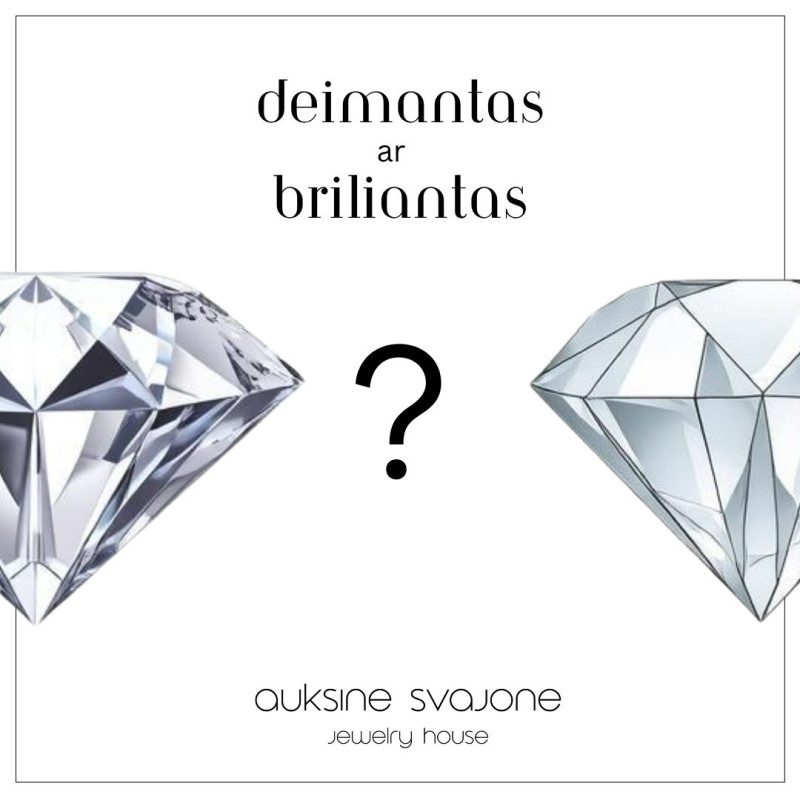
This is one of the most common questions. It seems simple, yet it often causes confusion.And for good reason – these two terms are frequently used as synonyms, even though they do not mean the same thing.
In everyday language, “diamond” and “brilliant” are often treated as identical, but in reality they refer to different things. When we talk about the difference, we usually simplify it: one is a natural stone, the other is a cut. However, the real distinction goes much deeper – into angles, proportions, and the path of light inside the stone.
A natural diamond, straight from the earth, does not have the sparkle we imagine. It only begins to “come alive” when a jeweler precisely shapes its facets. This is where the brilliant comes in – not just a polished stone, but a mathematically calculated structure designed to maximize light.
A classic brilliant cut typically has 57 or 58 facets. The top part is called the crown, the bottom the pavilion, and the edge between them the girdle. Each part has precise angles and proportions that determine how light enters and exits the stone.
The most important factor is the path of light. Ideally, light enters through the top, travels through the stone, reflects off the pavilion facets, and returns to the eye. This is what creates the “fire” and brilliance.
If the angles are off, light escapes through the sides or bottom. Even a large diamond can look dull. If the pavilion is too deep, the stone appears darker; if too shallow, it looks flat and lifeless. Even a few degrees can change everything.
According to jeweler Airidas Ulevičius, people are often surprised when comparing two stones of the same weight. One may look vibrant, the other almost “dead” – even though both are diamonds. The difference lies in the cut: precision, proportions, and facet arrangement.
Diamond and brilliant – are they the same?
Short answer: not quite.
A diamond is a natural gemstone found in nature.
What is a diamond?
A diamond is one of the hardest natural materials in the world.
It forms deep underground over millions of years under extreme pressure and temperature.
However, a natural diamond is not the sparkling gem we see in jewelry.
In its raw form, it:
- is irregular
- lacks strong brilliance
- looks quite plain
In other words, a diamond is the raw material.
What is a brilliant?
A brilliant is a diamond that has been professionally cut and polished.
Its shape is designed to:
- maximize light reflection
- create sparkle
- appear lively
A brilliant usually has 57–58 facets, which create its unique visual effect.
A brilliant is the finished result – a diamond shaped to reflect light as effectively as possible. That is what creates the sparkle we fall in love with.
The key idea is simple:
every brilliant is a diamond, but not every diamond is a brilliant.
Why is cutting so important?
This is where the biggest difference lies.
Even a high-quality diamond:
- can look dull if poorly cut
- or stunning if cut precisely
Cut often has more impact than size.
That is why the brilliant cut is so popular – it is designed to maximize light performance. When you see a sparkling ring, you are usually seeing not just a diamond, but a brilliant.
Why do people talk about brilliants?
Because this cut reveals the beauty of a diamond best.
People are usually looking not for “a diamond,” but for that visual effect – the play of light.
Final thought
The difference between a diamond and a brilliant is not just terminology.
It is the difference between raw material and a precisely engineered result.
A diamond is the beginning.
A brilliant is the result.
And that result determines whether a piece of jewelry simply exists – or truly stands out.

