
Contact us
+370 (675) 00 737
info@auksinesvajone.lt


To choose the right ring size, the most important thing is to know the ring’s inner diameter or the circumference of your finger. In Lithuania, the size is usually indicated by a number close to the ring’s inner diameter in millimeters. The ring size chart provided will help you compare sizes in mm and cm and choose the closest appropriate option.
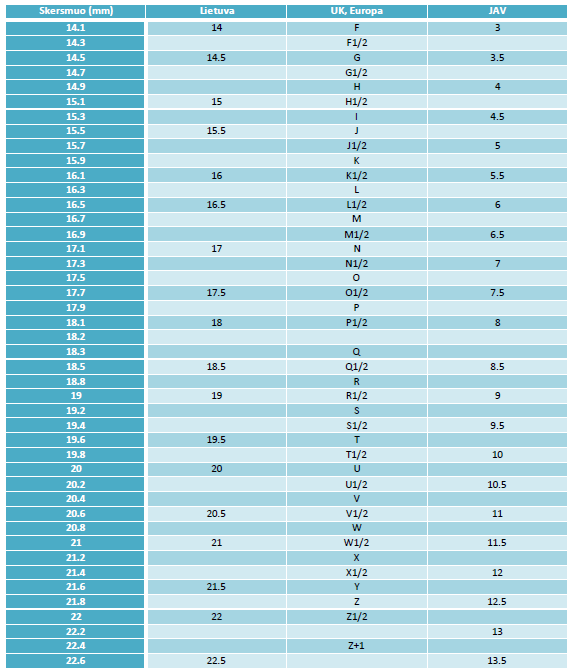
The table below shows the equivalents between Lithuanian ring sizes and inner diameters. The inner circumference of the finger or ring in centimeters is provided as a rough mathematical estimate.
In Lithuania, the ring size number corresponds to the ring’s inner diameter in millimeters. Sizes are usually given in intervals—for example, 16, 16.5, 17, 17.5, and so on. It is important to understand that the size number and the exact diameter do not always match to the nearest tenth of a millimeter. For example:
Therefore, when choosing a ring, it’s best to refer to a specific size chart rather than just the size number.
Find the value closest to your measurement in the “Inner Diameter” column. For example:
18.5 mm → size 18.5.
Find the closest value in the “Approximate Circumference” column. For example:
about 5.37 cm → size 17.
A ring’s inner circumference and diameter are directly related. Therefore, knowing one measurement allows you to estimate the other. A simple formula:
inner diameter ≈ circumference ÷ 3.14
For example, if the circumference is 53.7 mm—according to the size chart, this corresponds to approximately size 17:
53.7 ÷ 3.14 ≈ 17.1 mm
This formula can serve as a simple ring size calculator, but it’s best to choose the final size based on the specific retailer’s size chart.
No. One of the most common sources of confusion when buying a ring online is that different countries use different sizing systems. The chart includes three notations:
For example, a Lithuanian size 14 in this table corresponds to a UK size F and a US size 3. Therefore, when ordering a ring based on a foreign sizing system, it is recommended to first compare the inner diameter in millimeters—this helps avoid confusion between different notations.
If your measurement falls between two sizes in the chart, it’s not always worth rounding off purely based on math. The right choice may also depend on:
For more details on measurement specifics and choosing wider or narrower rings, read the article “How to measure finger sizes for a ring at home”.
The right size is especially important when choosing jewelry for everyday wear, such as an engagement ring or a wedding ring. Before choosing a specific model, it’s best to determine the size first and then browse through suitable rings.
If a ring you already own is too large or too small, the size of some rings can be professionally adjusted. “Auksinė Svajonė” offers ring resizing services, taking into account the type of metal, the ring’s construction, and any stones set in the ring.
If you already know the ring’s inner diameter or your finger’s circumference, compare the result to the ring size chart. If you don’t know the measurement yet, use our separate guide on how to measure your ring size at home.
The closest size listed in the chart is 17.5, which has an approximate inner circumference of 5.56 cm.
According to the size chart used, a Lithuanian size 17 corresponds to an inner diameter of approximately 17.1 mm.
No. The U.S. uses a different sizing scale, so a U.S. size cannot be directly equated to a Lithuanian size. The most reliable method is to compare the inner diameter of the ring and use a conversion chart.
The possibility of resizing depends on the specific construction of the ring. A professional jeweler can assess whether the ring can be safely enlarged or reduced.
If you’re still unsure between several sizes based on the chart, consult with a jeweler. Once you’ve chosen the right size, you can move on to the most important part—selecting the ring you’ll want to wear every day.